
 Custom Design. Factory Made. Globally Delivered CREAX


Bathroom Mirror Touch Switch: How to Choose, Specify, and Source the Right Solution
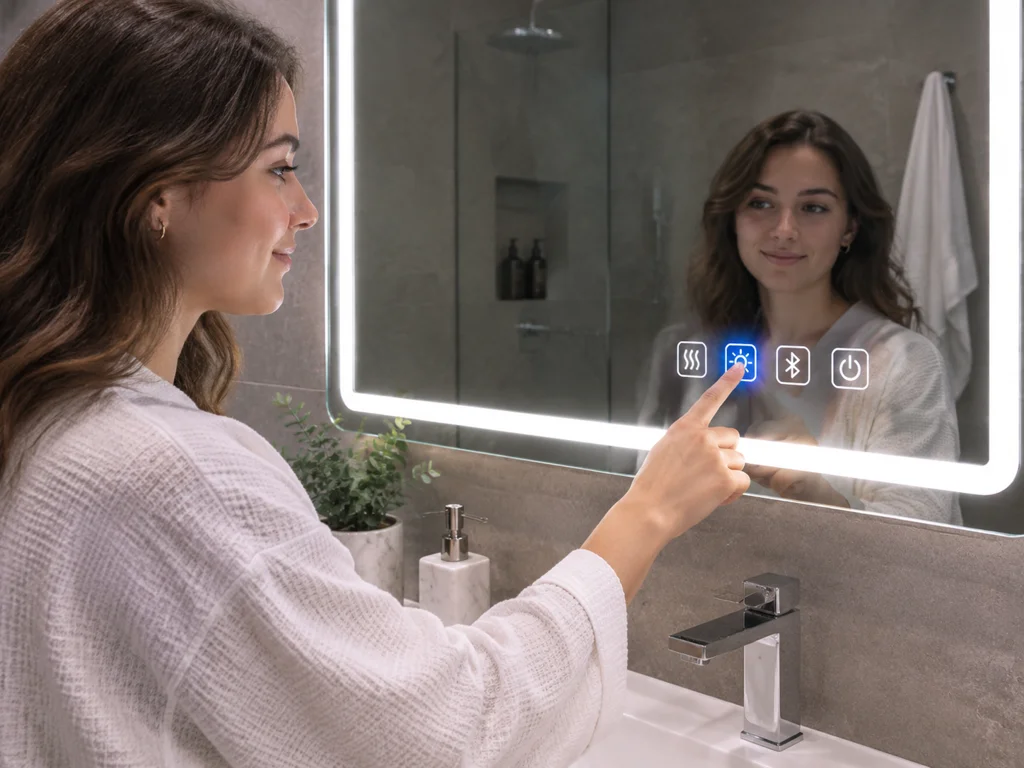
A bathroom mirror touch switch improves modern mirror design with clean operation, reliable control, and OEM flexibility. This guide explains selection, sourcing, and testing.
Bathroom Mirror Touch Switch: How to Choose, Specify, and Source the Right Solution
Bathroom Mirror Touch Switch: a Practical Summary for Buyers
A bathroom mirror touch switch is a compact control solution that lets users turn mirror lights, demisters, and other bathroom functions on and off with a simple touch. For brands, contractors, and distributors, the right model improves user experience, supports modern mirror design, and reduces visible hardware on the finished product.
In commercial purchasing, the best choice depends on more than appearance. You need to evaluate touch sensitivity, waterproofing, load capacity, installation method, and the supplier’s ability to deliver stable OEM bathroom mirror touch switch production. A reliable bathroom mirror touch switch manufacturer can help match the control module to LED power, glass thickness, and the target market’s safety expectations.
Why the Bathroom Mirror Touch Switch Has Become a Standard Feature
The bathroom mirror touch switch has moved from a premium feature to a widely expected detail in residential and hospitality mirrors. Buyers want cleaner aesthetics, fewer wall-mounted controls, and a more intuitive user experience. For mirror manufacturers, this shift matters because the switch is no longer just an accessory; it is part of the product identity.
In practice, the switch is usually integrated behind or through the mirror surface and connected to LED lighting, anti-fog pads, or dimming circuits. A good design can support single-function or multi-function control, such as one touch for light, long press for dimming, and memory for the last lighting state. This flexibility is particularly valuable in modern bathroom mirror lines where consumers expect minimal visual clutter.
From a sourcing perspective, the main advantage is consistency. Unlike mechanical buttons, a touch interface can be designed to look seamless across product ranges. That makes it easier for a bathroom mirror touch switch supplier to support different mirror sizes while keeping the same visual language. It also helps brands standardize the user experience across entry-level and premium collections.
There are, however, common mistakes. Some buyers focus only on the touch icon and overlook electrical compatibility. Others select a switch that works well in showroom conditions but performs poorly when installed behind thicker glass or in high-humidity environments. For bathroom applications, the control module should be chosen with moisture resistance, stable response, and long service life in mind. In many cases, a properly specified bathroom mirror touch switch outperforms a generic touch control because it is built around the actual mirror structure rather than adapted after the fact.
For independent brands, the bathroom mirror touch switch also plays a role in differentiation. It can support branded lighting scenes, custom logo illumination, and soft-touch activation that feels more premium to end users. When sourced correctly, it becomes a small part that adds visible value to the entire mirror assembly.
Key Technical Factors That Decide Performance
Before selecting a bathroom mirror touch switch, buyers should define the technical requirements in measurable terms. The most important factors are touch sensing method, voltage compatibility, protection rating, output load, and installation depth. If these are not confirmed early, the project may face delays during sample testing or mass production.
Touch sensitivity should match the mirror structure. Capacitive sensing is common because it provides smooth operation and a clean appearance. However, the sensor must be calibrated for glass thickness and nearby metal framing. In many projects, a mirror glass thickness of 4 mm to 6 mm is typical, but the exact response depends on the sensor design and mounting position. A bathroom mirror touch switch manufacturer should be able to explain how sensitivity changes with glass type, frosted backing, and printed icons.
Voltage and load are equally important. Many mirror lighting systems use 12V or 24V DC LED drivers, while some models may require specific switching capacity. If the switch only controls a low-current signal, it may need to be paired with a relay or controller. If it switches the load directly, the rated current and power must be verified. Buyers should request test data rather than relying on a general product description.
Protection against moisture is another critical point. Bathrooms expose electronics to condensation and humidity, so the switch housing, wiring interface, and seal design should be assessed. A well-made unit should support stable operation in everyday wet-room conditions, even if it is not directly exposed to water jets. For this reason, many OEM bathroom mirror touch switch projects include a review of enclosure materials, terminal protection, and cable routing.
Installation method also affects durability. Common options include behind-glass sensing, embedded modules, or hidden touch zones. Each method has pros and cons. Behind-glass sensing preserves the cleanest look but requires better calibration. Embedded controls may be easier to service but can be more visible. In procurement, the best approach is to match the control method to the mirror’s design language and target price point.
- Confirm glass thickness and sensor response before final tooling.
- Match voltage, current, and driver type to the lighting system.
- Check moisture resistance for long-term bathroom use.
- Choose the mounting style based on aesthetics and maintenance needs.
How to Evaluate a Bathroom Mirror Touch Switch Manufacturer
When comparing a bathroom mirror touch switch manufacturer, the first question is not price; it is capability. The supplier should be able to demonstrate stable production, quality inspection, and customization support for mirror projects. In B2B sourcing, a low unit price can become expensive if the switch fails during assembly or causes after-sales complaints.
A strong manufacturer will typically provide technical documentation, sample testing, and clear specification sheets. Look for details such as operating voltage, sensing distance, rated life, and environmental limitations. If the factory cannot explain how the touch circuit behaves with different mirror coatings or how the LED output is controlled, that is a warning sign. The best suppliers can discuss both the electrical design and the practical installation environment.
Another important factor is consistency between sample and production. In mirror manufacturing, even small changes in sensitivity can affect the user experience. A good bathroom mirror touch switch supplier should have process controls that keep the product stable across batches. This includes incoming component checks, functional testing, and packaging that protects the switch during shipment.
OEM support is especially valuable for brands with unique designs. For example, some projects require a specific symbol, custom backlight color, or touch zone positioned to match the mirror frame. An OEM bathroom mirror touch switch program should also support cable length adjustments, connector customization, and compatibility with the lighting circuit used by the mirror factory. If the manufacturer has experience serving different mirror categories, such as hotel vanity mirrors, smart LED mirrors, and cosmetic mirrors, that usually indicates stronger application knowledge.
Buyers should also review lead times and engineering response speed. A supplier that answers technical questions quickly can shorten development cycles and reduce costly rework. In many cases, the best long-term partner is the one that understands how the switch fits into the entire mirror assembly, not just one component on the parts list.
- Request specification sheets and test parameters before sampling.
- Ask for OEM customization options and minimum order quantities.
- Review production stability, not just sample appearance.
- Check whether the supplier understands mirror assembly workflows.
OEM Bathroom Mirror Touch Switch Projects: What Can Be Customized
OEM bathroom mirror touch switch projects are often the best choice for brands that want a recognizable product line. Customization can range from visual details to electrical behavior. The key is to define what must stay standard and what can be adjusted without affecting reliability.
Common customization points include icon shape, touch zone size, backlight color, cable length, connector type, and function logic. For example, a hotel project may require a single-touch on/off switch with a softly illuminated symbol, while a premium residential line may need dimming, memory, or dual control for light and demister. A bathroom mirror touch switch manufacturer can usually adapt these features if the project brief is clear.
Material selection also matters. The external surface may need to blend with mirrored glass, black backing, or brushed frame finishes. Internal components should be selected for long-term stability in humid environments. While the buyer may see only a small touch point, the product must still withstand repeated daily use. Depending on project requirements, the switch may also be paired with ABS, PC, or metal mounting elements, though the exact configuration should follow the mirror design and safety requirements.
In real production, customization should be approached systematically. First, define the mirror type, target market, and end-user behavior. Second, confirm voltage, wiring, and switching logic. Third, ask for a prototype and test it in actual mirror samples. This process reduces the risk of mismatched sensitivity or poor light response after mass production starts. For large programs, it is also useful to document acceptable tolerances for response time, indicator brightness, and installation positioning.
One common misconception is that OEM means cosmetic customization only. In reality, the most valuable OEM bathroom mirror touch switch changes often happen at the functional level. A well-designed switch can improve assembly efficiency, reduce visible hardware, and make the finished mirror easier to use. For export projects, it can also help align the product with regional preferences, such as minimalist design in Europe or multi-function convenience in hospitality markets.
Comparison of Bathroom Mirror Touch Switch Options
Not every mirror project needs the same control solution. The best choice depends on product positioning, safety requirements, and the degree of integration with lighting or defogging systems. The table below compares common options used in bathroom mirror applications.
| Type | Main Advantages | Main Limitations | Best Use Case |
|---|---|---|---|
| Capacitive touch switch | Clean appearance, smooth user experience, easy to integrate | Needs calibration for glass thickness and mounting conditions | Modern LED bathroom mirrors |
| Mechanical push switch | Simple operation, familiar feedback, easier to understand | More visible hardware, less premium appearance | Budget mirrors or utility installations |
| Touch sensor with dimming | Better lighting control, premium feel, supports user preference | More complex circuitry and testing | High-end mirrors and hospitality products |
| Multi-function touch module | Can control light, defogger, and memory functions | Requires clear logic design and more careful installation | Smart mirrors and OEM projects |
For many brands, the capacitive bathroom mirror touch switch is the best balance between appearance and performance. It creates a seamless front surface and is easy for end users to understand. However, if the mirror will be sold into a harsh-use environment or a low-cost channel, a simpler control may be more practical.
The challenge is not choosing the most advanced option; it is choosing the most appropriate one. For example, a hotel vanity mirror may benefit from a dimmable touch switch because guests appreciate adjustable brightness. A utility bathroom mirror in a rental property may need only a reliable on/off function. The decision should be driven by the product brief, not by feature count alone.
When sourcing from a bathroom mirror touch switch supplier, ask for sample comparisons under real mounting conditions. Test the switch in the actual mirror assembly rather than on a bench. This reveals whether the sensor remains stable through the glass, whether the indicator is visible enough, and whether the user can find the touch point naturally. These small checks often determine whether the final product feels polished or frustrating.
Installation, Testing, and Common Mistakes to Avoid
Even a well-designed bathroom mirror touch switch can underperform if installation is poor. For mirror manufacturers and installers, the first rule is to keep the sensing area aligned with the intended touch symbol. Misalignment can lead to weak response, accidental activation, or inconsistent user behavior. During assembly, the sensor position should be fixed according to the approved drawing, and the wiring should be routed away from heat sources and sharp edges.
Testing should include more than a basic on/off check. A proper validation process often includes repeated touch cycles, moisture exposure, power interruption recovery, and compatibility testing with the connected LED driver. In production, it is helpful to simulate real use by checking how the switch responds after the mirror has warmed up. Temperature changes can affect some sensor behaviors, especially when the switch is mounted near LED strips or anti-fog elements.
A frequent mistake is selecting a switch without confirming the mirror’s back structure. Printed backing, reflective coatings, frame metal, and adhesive layers can all influence sensing performance. Another common issue is underestimating cable management. If the wiring is too tight or poorly supported, vibration during transport may damage the connector or create intermittent faults. A thoughtful OEM bathroom mirror touch switch design should include space for safe cable routing and secure mounting.
Buyers should also avoid comparing products only by sample feel. A switch that seems responsive in a showroom may behave differently once installed behind thicker glass or connected to a different driver. That is why a bathroom mirror touch switch manufacturer should always be asked for application notes, installation guidance, and recommended test procedures. These materials save time and improve consistency across mass production.
For distributors, after-sales issues usually come from unclear expectations. If the end customer expects dimming but the model is on/off only, dissatisfaction is almost guaranteed. Clear product labeling and accurate technical documentation are essential. The more precisely the function is defined at the beginning, the fewer problems appear later in the supply chain.
- Test the switch in the actual mirror assembly, not only on a sample board.
- Verify cable length, routing, and connector fit before mass production.
- Confirm user logic, especially for dimming or multi-function controls.
- Document the approved installation position to avoid batch variation.
How to Source the Right Bathroom Mirror Touch Switch for Your Market
Successful sourcing begins with product positioning. If your mirror line targets premium residential buyers, the bathroom mirror touch switch should support a refined appearance, stable sensing, and optional multi-function control. If your target is hospitality or project sales, consistency, durability, and easy assembly may matter more than advanced features. In either case, the supplier must understand how the switch fits into your production flow.
Start by defining the project in three layers: functional requirements, mechanical constraints, and commercial targets. Functional requirements include on/off, dimming, memory, or defogger control. Mechanical constraints include glass thickness, mounting space, and wiring layout. Commercial targets include MOQ, lead time, and acceptable unit cost. When these layers are clear, the bathroom mirror touch switch supplier can offer a more accurate solution instead of a generic catalog item.
It is also wise to request samples in the exact intended configuration. A switch that is suitable for one mirror size may not behave identically in another. For export programs, confirm whether the product can be adapted to market-specific voltage standards and documentation needs. An experienced bathroom mirror touch switch manufacturer will usually support technical communication before and after sampling, which reduces risk during new product development.
For brands building a long-term line, the best approach is to create a standard platform with controlled customization. This means the base electrical design remains stable while the visual interface, wiring length, or function label changes by model. That strategy simplifies sourcing, improves quality control, and helps the final mirror collection look coherent across different sizes and price tiers.
Ultimately, a well-chosen bathroom mirror touch switch does more than turn a light on and off. It strengthens product perception, supports efficient assembly, and contributes to a cleaner bathroom design. If you are developing a new mirror series or upgrading an existing one, work with a supplier that can balance design, reliability, and OEM flexibility from the start.
If you are planning a new project or need a customized bathroom mirror touch switch solution, contact us to discuss specifications, samples, and OEM options. A clear technical brief today can save time, reduce risk, and help your mirror product reach the market with confidence.
You might also be interested in
A bathroom mirror touch switch improves modern mirror design with clean operation, reliable control, and OEM flexibility. This guide explains selection, sourcing, and testing.
Smart Mirror Touch Switch: A Practical Selection and Design Guide
Learn how to select, install, test, and source a smart mirror touch switch for reliable lighting, demisting, and control in residential and commercial applications.

The Complete Guide to Mirror Touch Switch Modules: Technology, Manufacturing, and Customization
Explore the technology, manufacturing quality, supplier logistics, and customization of mirror touch switch modules, including specs, installation tips, and smart home trends.

The Complete Guide to Mirror Switch Modules: Technology, Selection, and Installation
A mirror switch module controls lighting, dimming, and defogging in smart bathroom mirrors. This guide covers capacitive, infrared, and mechanical types, key electrical specifications, installation steps, selection criteria, and quality-testing practices for reliable LED mirror applications.